


When designing an automation project that involves moving objects or some kind of repetitive motion function, the project will benefit from the inclusion of robots. Choosing the right type of robot will reduce the design cost and increase the success rate. Simple applications use only a set of repeated programmed motions, but adding a machine vision system, or adding a set of field sensing devices connected to the robot control system, can allow the robot to achieve adaptive motion, which can change the actual motion of the robot.
Robot vendors can help users select systems with positioning capabilities. There are many videos on the Internet that show robotic systems in a variety of motions, so keep in mind that when watching these videos, if they are from the manufacturer, the robot in the video is usually operating at the limit of its performance. But in practical use, it is not possible for the robot to run continuously when its performance is at its limit.
Many robot manufacturers offer modeling and simulation software to help customers choose the robot that best meets their needs. "LOSTPED" helps to define the information needed to develop robot parameters, load, trend, speed, operation, accuracy, environment and mission cycle are the data points needed to properly plan and design a robotic system or any motion control application.
There are several general robot types that can be selected by the customer. Each robot has some additional features to customize the application according to the customer's requirements.
Multi-joint robot
When most people think of industrial robots, they picture some sort of multi-articulated robot. This type of robot often appears in television commercials and industry-related videos. There is no strict definition of a multi-articulated robot, which is described as having a fixed base with 4 to 6 axes of joints. In fact, there are articulated robots with as few as 2 axes and as many as 10 axes. In addition, the robotic arm End Tool (EOAT) can provide more motion options. A standard feature of multi-joint robots is their ability to operate in a 3D space or workspace. The largest workspace of a multi-joint robot is similar to a sphere, and it usually defines points in the space using a polar coordinate system.
The multi-joint robot is widely used because of its large working range, it can place the end tool of the robot arm on a nearly infinite number of planes at almost any Angle. For example, in welding, a multi-joint robot using either welding technique is more continuous and repeatable than a human. When the workpiece is in a fixed position, the welding nozzle can precisely locate the optimal distance, Angle and speed. Even if the workpiece is not perpendicular to the robot base, the robot can utilize the 3D laser and machine vision for accurate and repeatable inspection. Other applications of multi-articulated robots include painting, drilling, tapping, cutting, pick-and-place, material handling, packaging, and assembly.
Among the types of robots discussed in this paper, multi-joint robots are priced higher. Programming simple motions of a multi-joint robot can usually be accomplished by teaching points and actions directly, and complex positioning requires writing code for the controller. Field workers can modify or fine-tune the position of the robot.
SCARA robot
The Selective Compliance Assembly Robotic Arm Robot (SCARA) has a firm base in a fixed position, its robot arm is fixed on the z axis, while rotating in the xy axis. There is an additional xy axis joint in the middle of the robot arm, a linear actuator at the end of the arm makes the Z axis move at 90 degrees to the base plane, and the linear actuator has an additional θ axis. So the scara robot has four axes in total. In many ways, the SCARA robot mimics the movement of a human arm, and the largest workspace of the robot is equivalent to a part of a cylinder.
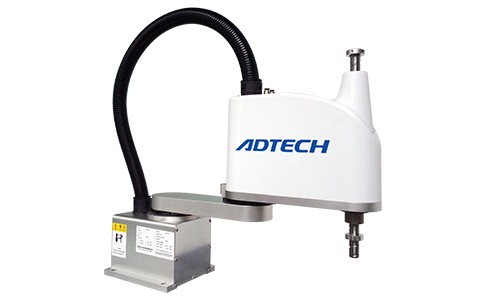
In operation, the SCARA robot arm can operate at high speed while maintaining high precision positioning. If the operating planes are all parallel to each other, then material handling and product assembly can often be done using the SCARA robot arm. The use of a displacement laser at the end of the tool enables high-speed cubic coordinate measuring instrument (CMM) functions on the assembly line. The SCARA robot equipped with a machine vision system can complete precise non-contact inspection. The installation of lasers, plasma cutters, and routers at the tool end of the robotic arm enables precise etching, cutting, and milling operations.
The weight of the object that the SCARA robot bears creates radial loads on its rotating joints, so its bearings must be strong enough to function fully over the expected lifespan of the robot. The momentum of the SCARA robot load must not be so high that the motors slow down and the arm stops moving.
Rectangular coordinate robot
Cartesian robots can often handle heavier loads than multi-joint robots or SCARA robots at a lower cost. The rectangular coordinate robot uses the frame structure to share the load weight (FIG. 3). The Cartesian robot moves linearly in the x, y, and z axes, and it is also constrained to move within a frame that can be hundreds or thousands of meters or feet long. The frame can be a standard or semi-standard linear slide and ball screw, such an architecture allows the rectangular coordinate type robot to change purpose if necessary. The workspace of the Cartesian coordinate type robot is similar to a rectangle, and it uses a Cartesian coordinate system for positioning.
Rectangular coordinate robots are often used to pick and place products, but also to apply sealants, control routers, lasers and plasma cutting machines or any motion suitable for the robot workspace.
Delta robot
The Delta robot has three parallel sets of arms and rotary or linear actuators. When a force is applied to the actuator, the end-effector moves in the x, y, and z axes but does not rotate. The Delta robot is designed for pickup and place with light loads, but other uses include 3D printing, surgery, and assembly operations. Delta robots use lightweight arms that have very little inertia and move very fast. Unlike the manipulator, the Delta robot can move in a 360-degree circular motion within its workspace.